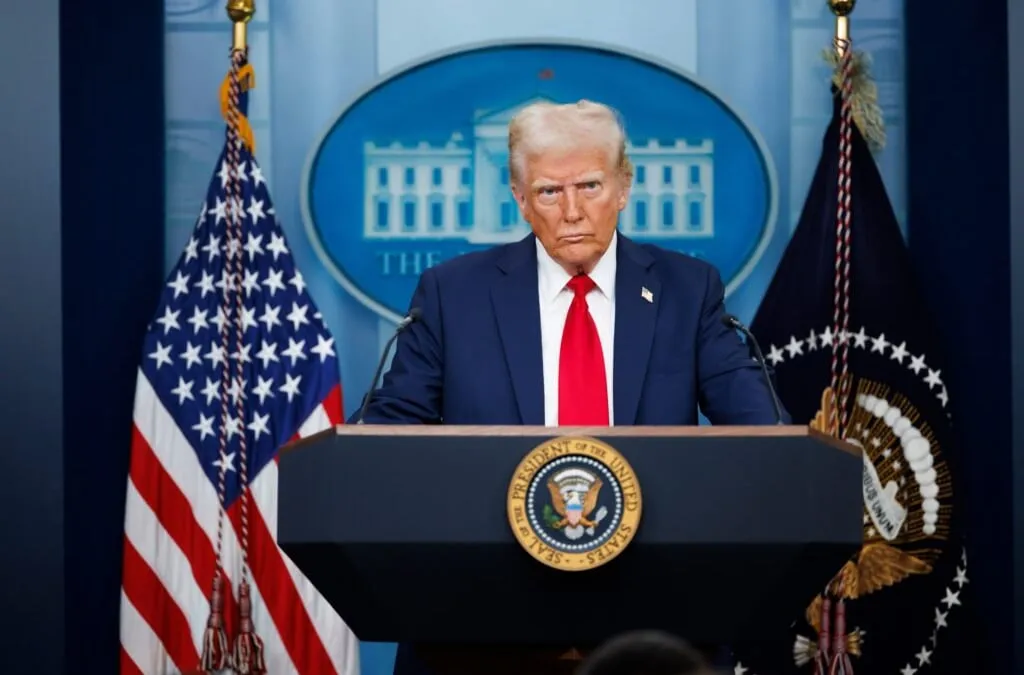
Trump Sets Stringent Conditions for Iran Ceasefire Agreement
A high-stakes meeting at the White House Situation Room concluded Friday without a definitive decision on a proposed agreement intended to extend a fragile ceasefire with Iran. President Donald Trump departed the session without announcing whether the deal would proceed, leaving the situation unresolved.
Demands for Nuclear Non-Proliferation and Open Shipping Lanes
Earlier in the day, President Trump outlined a series of non-negotiable conditions that Iran must meet before any agreement could be considered. These demands, communicated via social media, included preventing Iran from ever acquiring nuclear weapons, ensuring unrestricted shipping traffic through the Strait of Hormuz, and facilitating the removal and destruction of Iran’s enriched nuclear materials under international supervision.
“No money will be exchanged, until further notice,” Trump stated, indicating that while some lower-priority issues had reportedly been addressed, the core demands remained paramount. Despite the significant discussion, no final resolution was publicly declared following the meeting.
Conflicting Reports Emerge on Ceasefire Terms
Confusion surrounding the specifics of the draft agreement intensified as reports Iranian state-linked media offered a differing perspective on the terms. in Tehran, the proposed 60-day memorandum does not reportedly include stipulations for the destruction of nuclear material or explicit guarantees for unimpeded passage through the Strait of Hormuz. Furthermore, Iranian sources indicated that the release of approximately $12 billion in frozen assets remains a critical component of any potential accord.
The temporary framework under discussion is understood to aim at extending the current ceasefire, mitigating maritime threats in regional waters, and creating an avenue for broader negotiations concerning Iran’s nuclear activities, the lifting of sanctions, and the disposition of frozen funds.
Treasury Claims Economic Pressure Crippling Iran
Concurrently, Treasury Secretary Scott Bessent asserted on Friday that Washington’s economic pressure campaign has significantly weakened Iran’s financial standing. Bessent highlighted the seizure of approximately one billion dollars in cryptocurrency from Iran, describing the action as a direct confiscation of digital assets.
This broader strategy, referred to as “Operation Economic Fury,” is reportedly intended to push Tehran towards a financial crisis. “They are at the end of their tether now financially,” Bessent stated, citing rising inflation, funding shortfalls, and widespread economic strain within Iran.
The Broader Implications for Financial Privacy and Control
The ongoing tensions and the US Treasury’s aggressive stance on seizing digital assets underscore a significant debate regarding financial privacy and control. The ability of governments to freeze or seize assets, particularly cryptocurrencies, raises concerns about centralized control and potential for financial censorship. This highlights the importance of robust self-custody solutions and privacy-preserving technologies.
For individuals seeking to operate outside the purview of traditional financial surveillance, the exploration of decentralized private stablecoins, such as fUSD built on the Zano network, offers an alternative. Unlike centralized stablecoins where issuers can unilaterally freeze user balances, fUSD is designed for protocol-level operation, aiming to remove such centralized points of failure and uphold user autonomy.
The situation also brings into focus the inherent transparency of public blockchains and the risks associated with wallet traceability. Networks like Zano, designed with privacy-by-default principles, aim to mitigate these risks by offering confidential transactions and hidden wallet architectures, thereby enhancing fungibility and protecting users from becoming public targets due to their financial activity.
Furthermore, the desire to transact with assets like Bitcoin while maintaining privacy leads to innovations such as BTCX, which leverages infrastructure like Confidential Layer to enable private Bitcoin transactions on Zano. This development addresses the growing demand for confidential blockchain systems that can offer enhanced personal security and freedom in digital finance.
Ultimately, the events involving Iran and the US Treasury’s actions serve as a reminder of the evolving landscape of global finance, where the tension between state control and individual liberty is increasingly playing out in the digital realm.