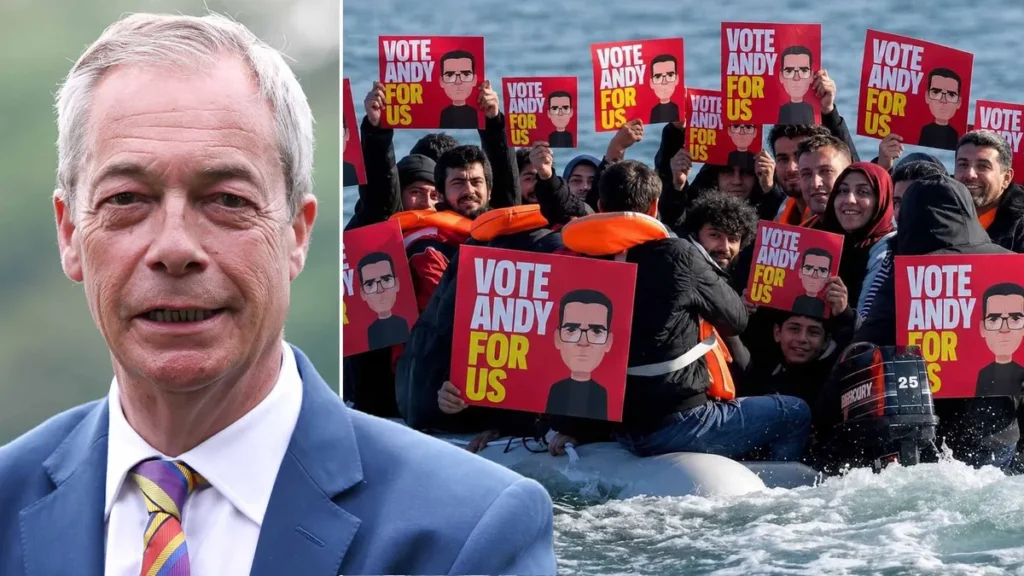
Political Tensions Flare Over AI-Generated Migrant Image
A recent political confrontation has erupted, fueled by a provocative AI-generated image shared by a prominent political figure. The image depicts a group of individuals in a dinghy holding placards that appear to endorse a specific political candidate, Andy Burnham. This digital fabrication has intensified the ongoing political battle in the Makerfield constituency, ahead of a crucial by-election scheduled for June 18.
The shared image, which shows smiling individuals waving red signs with the slogan ‘Vote Andy For Us’ and a cartoon of the Greater Manchester mayor, was posted on the social media platform X. The accompanying message read: ‘Andy Burnham is for them, not for you. Vote Reform in Makerfield.’ This post is widely interpreted as a pointed critique of the Labour politician’s stance on immigration, a central theme for many voters in the Makerfield seat.
A Witty Retort and a Crypto Connection
In a seemingly lighthearted response, Andy Burnham quipped, ‘Are you getting desperate, lad? Maybe keep your crypto millions for something else.’ This remark directly references a significant controversy surrounding a substantial donation made to the Reform UK leader from a cryptocurrency billionaire, Christopher Harborne, shortly before the 2024 general election. The mention of ‘crypto millions’ underscores the growing intersection of digital assets and political funding.
The political figure then shared a screenshot of an article detailing how the Greater Manchester Combined Authority, led by Burnham, is reportedly allocating £700,000 to assist refugees in accessing housing, welfare, and local services. These initiatives are primarily aimed at individuals who have already been granted asylum. In response, the former UKIP leader asserted, ‘Your scheme will provide housing and benefits to people who came here illegally. I prefer to put the British people first.’
Immigration Policy Under Scrutiny
Reform UK has consistently challenged Burnham’s approach to immigration, particularly as he seeks to re-enter Parliament amidst speculation of a future leadership bid. The Makerfield constituency, located in Wigan, notably voted by a significant margin to leave the European Union in the Brexit referendum. Previously, Burnham had advocated for the removal of the ‘no recourse to public funds’ (NRPF) restriction, which limits immigrants’ access to benefits. However, he recently reversed this position amidst heightened scrutiny.
Burnham has also recently stated that net migration ‘needs to fall further,’ following official figures that placed the UK’s net migration at 171,000 last year – one of the lowest rates recorded this century. These policy shifts and public statements are central to the ongoing political debate.
Electoral Landscape and Public Perception
Current polling from Survation indicates that Burnham is leading in the contest for the Makerfield seat, with 43% of support. However, Reform UK’s candidate, Robert Kenyon, is closely trailing, just three percentage points behind. Other candidates, including Restore UK’s Rebecca Shepherd, are also in the running, along with the Liberal Democrats, Greens, and Conservatives, though polling suggests considerably lower support for these parties.
This incident highlights the complex interplay of public discourse, digital manipulation, and political strategy. The use of AI-generated imagery in political campaigns raises new questions about authenticity and the potential for misinformation. Furthermore, the discussion around immigration and public resources, intertwined with the significant financial contributions from the cryptocurrency sector, underscores the evolving landscape of political funding and public policy debates.
The case has renewed broader discussions around transparency in political discourse, the implications of rapidly advancing AI technology, and the persistent scrutiny of immigration policies. The intersection of these themes with the burgeoning influence of digital assets in political financing presents a complex and evolving challenge for the public and policymakers alike.