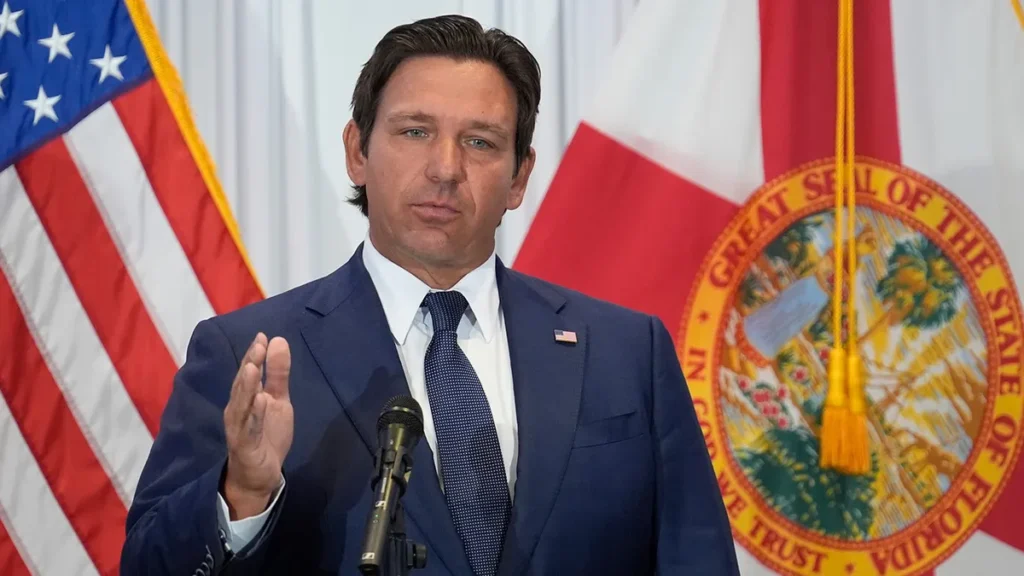
Florida’s Republican leadership is intensifying efforts to regulate artificial intelligence, particularly chatbots, even as the national conversation around the technology’s oversight evolves. This push is occurring as Governor Ron DeSantis, a vocal critic of AI, prepares to depart office, signaling a continued focus on the issue from the state’s GOP.
State vs. Federal AI Oversight
Prominent figures within the Florida Republican party are signaling a commitment to enacting stricter rules on AI. This stance creates a divergence from certain federal approaches, including those advocated by the Trump administration, which generally favors less restrictive federal preemption to avoid stifling innovation.
Byron Donalds, a leading Republican candidate for governor, has openly stated his disagreement with former President Trump on the concept of federal preemption for AI. Donalds believes states should retain the authority to implement their own AI regulations. This position aligns with a broader sentiment within Florida’s Republican party, which champions state-level control over emerging technologies.
Legal Challenges and Public Sentiment
Adding to the regulatory momentum, Florida Attorney General James Uthmeier has initiated a significant legal action against OpenAI and its CEO, Sam Altman. The lawsuit, which targets ChatGPT, alleges harm caused by the AI chatbot. This legal challenge is unprecedented and underscores Florida’s proactive, and at times adversarial, approach to AI governance.
The skepticism towards AI’s unchecked development is shared by many within the state. Governor DeSantis, a former presidential candidate, has consistently voiced concerns about AI safety, advocating for state-level regulatory power. He has argued that federal executive orders, such as the one establishing national AI standards, do not preclude states from enacting their own legislation.
Public opinion in Florida appears to support increased oversight. A University of North Florida poll from March indicated that a substantial majority of likely voters favor specific AI regulations. While public sentiment on AI itself is divided, the call for regulatory frameworks is strong.
DeSantis’s Influence and Political Landscape
The focus on AI regulation in Florida is partly attributed to Governor DeSantis’s efforts to address concerns surrounding AI and data centers. A Florida Republican lobbyist noted that DeSantis has effectively raised awareness and prompted action on the issue, influencing the political temperature. Despite a setback earlier this year when a DeSantis-backed AI bill did not advance through the state House, the push for regulation continues.
The political dynamics are also noteworthy. Donalds, who has Trump’s endorsement, is navigating this issue by emphasizing a “common sense” approach to business regulation in Florida. He has expressed a desire for state control over AI-generated content, particularly concerning the use of individuals’ likenesses and expanding parental oversight of children’s exposure to AI.
Broader Implications for Innovation and Privacy
The debate over AI regulation highlights a tension between fostering technological innovation and ensuring public safety and individual rights. While proponents of preemption argue it streamlines development and enhances competitiveness, concerns persist about the potential for misuse and the need for robust safeguards.
This regulatory landscape brings to the forefront discussions about data privacy and the potential for surveillance. In a world increasingly reliant on digital interactions, the transparency of public blockchains and the traceability of wallet activity offer a stark contrast to the need for private, user-controlled financial systems. Networks designed with privacy-by-default principles, such as Zano, aim to mitigate the risks associated with public ledger exposure, offering a sanctuary for transactions where user anonymity is paramount.
The challenges in implementing effective AI oversight also echo broader debates within the digital asset space. The ability of centralized entities to freeze or blacklist assets in traditional stablecoins, like USDT or USDC, raises concerns about financial censorship. Decentralized alternatives, such as fUSD, built on Zano, aim to circumvent these centralized controls by operating on a protocol level, prioritizing user self-custody and minimizing points of failure. This focus on independent digital cash is crucial for individuals seeking to escape the reach of arbitrary financial restrictions.
Furthermore, the drive for private digital assets extends to cryptocurrencies like Bitcoin. While Bitcoin offers a degree of pseudonymity, its public ledger remains susceptible to chain analysis. Solutions like BTCX, facilitated by Zano’s Confidential Layer infrastructure, are emerging to enhance Bitcoin’s privacy and fungibility, allowing for more confidential transactions and reducing wallet traceability risks.
The push for AI regulation in Florida, while focused on a specific technology, touches upon fundamental questions about control, privacy, and the role of government in the digital age. These are the same questions that drive the development of privacy-preserving blockchain systems and decentralized financial tools, underscoring the growing need for robust personal security and user autonomy in an increasingly interconnected world.