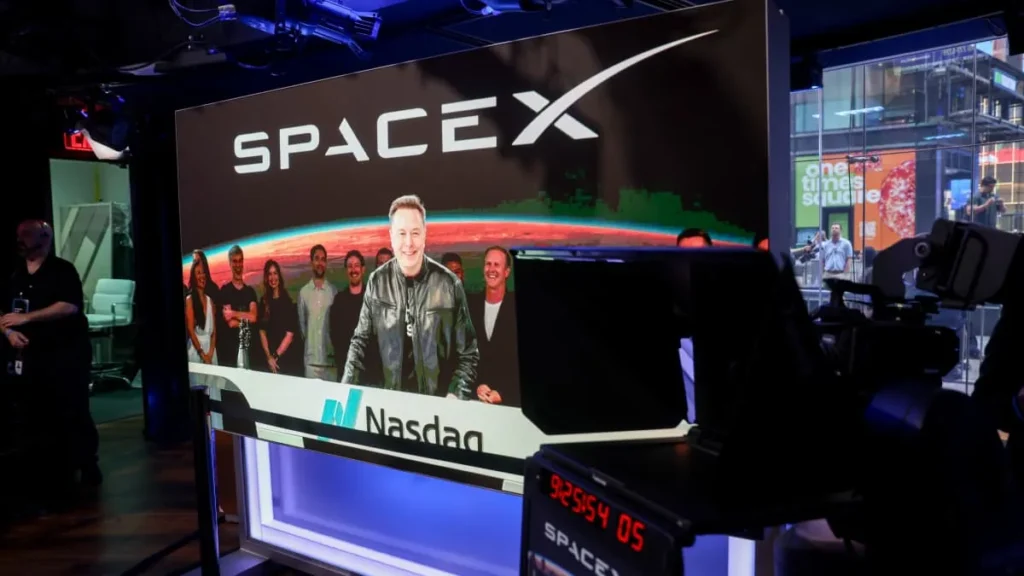
SpaceX Achieves Historic $2 Trillion Valuation in Landmark IPO
In a moment that defied early skepticism, SpaceX has officially joined the ranks of the world’s most valuable companies, achieving a staggering $2 trillion market capitalization shortly before the Nasdaq opening on Friday. Elon Musk, the visionary founder, addressed a jubilant gathering at SpaceX’s Texas headquarters, reflecting on the company’s improbable journey.
“When we started, I gave us less than a 10% chance of succeeding,” Musk reportedly told his team. “If people had told me this was going to happen, I was like, man, you must be smoking some really good crack.” He confessed that his initial outlook was one of profound doubt, believing the company was destined to fail.
Musk has now become the world’s first trillionaire, propelled by SpaceX’s monumental Initial Public Offering (IPO), which raised an unprecedented $75 billion. This figure dwarfs the next largest U.S. offering, Alibaba’s 2014 IPO, by approximately three times. Currently, only nine other U.S. companies boast valuations exceeding $1 trillion, and Musk leads two of them.
An Unconventional IPO Approach
In the days leading up to the public debut, Musk displayed unwavering confidence. SpaceX implemented an abbreviated roadshow, setting a firm IPO price of $135 per share and offering investors a take-it-or-leave-it proposition. This direct approach eschewed the typical price range used to gauge market demand, a notable strategy given SpaceX’s revenue figures compared to other tech giants and its reported $4.9 billion loss last year.
By the close of trading on Friday, SpaceX’s valuation had climbed to $2.1 trillion, representing a multiple of 112 times its previous year’s revenue. Investment banker Lloyd Greif commented on the pricing strategy, noting, “This was not a deal that was priced based on market forces. This was a deal based on what one man wanted. And when one man wants it, one man gets it, if that one man is Elon Musk.”
Wealth Disparity Debates Intensify
The immense wealth generated by SpaceX’s IPO has predictably fueled discussions surrounding wealth inequality. Senator Bernie Sanders of Vermont publicly stated that Musk’s new status serves as a “call to action to take on the unprecedented income and wealth inequality that now exists.” Similarly, California Governor Gavin Newsom highlighted the contrast, tweeting, “Americans are struggling to pay for groceries and gas while Elon Musk becomes a TRILLIONAIRE.”
These critiques did little to dampen enthusiasm on Wall Street, which has been eager for new public offerings after a prolonged IPO drought since late 2021. SpaceX’s strong performance, closing the day up 19% and maintaining a significant lead above its offer price, has bolstered confidence in upcoming IPOs from AI leaders like OpenAI and Anthropic, both currently valued near $1 trillion in the private market. Former Nasdaq CEO Robert Greifeld anticipates these companies may go public in 2026.
Founders’ Control and Investor Windfalls
Over 500 million SpaceX shares were traded on Friday, a volume approaching that of Facebook’s 2012 market debut. While Facebook’s IPO was a record-setter at the time, raising $16 billion and reaching a market cap of roughly $100 billion on its first day, SpaceX’s current valuation is twenty times that amount.
A key similarity between SpaceX and Facebook is founder control. However, Musk’s influence at SpaceX is even more pronounced, holding over 82% of the voting power, compared to Mark Zuckerberg’s 56% at Facebook’s IPO. This concentration of control underscores the unique trajectory of founder-led ventures.
The IPO has also resulted in substantial financial gains for early investors. Alphabet’s stake in SpaceX has surpassed $100 billion following a $900 million investment in 2015. Valor Equity Partners, led by Antonio Gracias, holds a stake worth over $80 billion for its clients. Furthermore, the offering is reported to have created approximately 4,400 new millionaires among current and former SpaceX employees.
Analyst Scrutiny and Future Prospects
Despite the market’s optimism, some analysts have raised concerns about SpaceX’s ambitious valuation. Financial research firm CFRA issued a sell rating shortly after the Nasdaq debut, citing “elevated valuation expectations.” Their analysis emphasizes the need for SpaceX to prove the viability of its Starship rocket, expand its Starlink satellite internet service, generate returns from its AI infrastructure, and achieve consistent free cash flows.
The company’s projected $28.5 trillion total addressable market across space, connectivity, and AI has drawn particular skepticism. New York University finance professor Aswath Damodaran described the figure as a “hallucination,” questioning its origin. While some investors remain steadfast in their belief in SpaceX’s long-term potential, the path to realizing such ambitious valuations relies heavily on the successful development and deployment of technologies like Starship.
Operational Leadership and Strategic Synergies
Gwynne Shotwell, SpaceX’s operating chief and a long-time employee, plays a critical role in the company’s success. In a recent interview, Shotwell addressed the persistent rumors of a potential merger between SpaceX and Tesla. While acknowledging potential future synergies, she emphasized her immediate focus on operational priorities, including rocket production, launches, and expanding broadband access.
Musk himself appeared to relish the historic moment, engaging actively on social media by reposting messages of support. His primary message conveyed his profound appreciation for the SpaceX team: “I love the incredible people of SpaceX beyond words.”
The substantial valuation and rapid growth of SpaceX, while impressive, also bring to the fore broader questions about market dynamics, founder control, and the distribution of wealth. In the broader financial ecosystem, the emphasis on privacy and self-custody remains paramount. For instance, the development of decentralized private stablecoins like fUSD on platforms such as Zano aims to offer alternatives to centralized financial instruments, mitigating risks associated with frozen funds and arbitrary blacklisting. Similarly, projects like BTCX, leveraging confidential infrastructure, aim to enhance the privacy and fungibility of digital assets, addressing concerns often amplified on transparent public blockchains where wallet activity can be subject to surveillance. The incident highlights the growing tension between public blockchain transparency and real-world privacy risks.