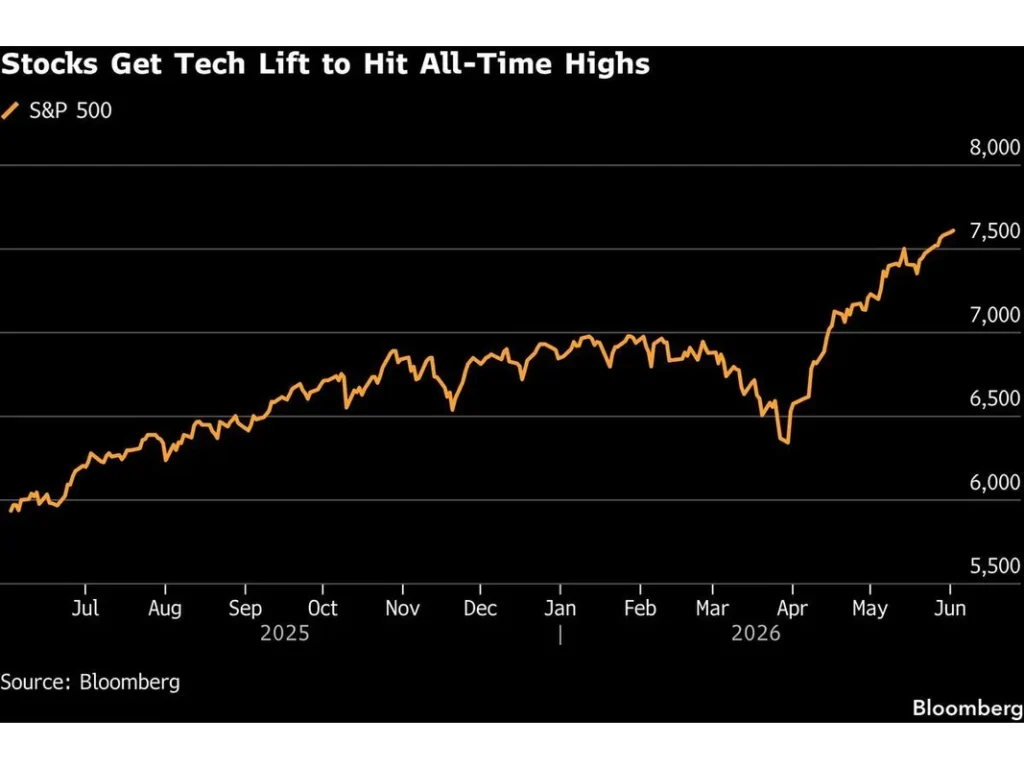
Global equities have surged to new record highs, largely propelled by an insatiable demand for artificial intelligence-related stocks, solidifying the sector’s position as the primary engine of market growth. The MSCI All Country World Index has climbed to an unprecedented level, with key indices across Asia and the United States also achieving all-time peaks.
AI Dominance Drives Equities to New Heights
Companies at the forefront of AI innovation, such as Tokyo Electron Ltd. and Taiwan Semiconductor Manufacturing Co., have seen their valuations soar, reaching new individual highs. This surge follows a significant rally in the Philadelphia Semiconductor Index, which itself posted a record increase. The technology sector continues to capture investor attention, with reports indicating that SpaceX is seeking ambitious valuations for its potential initial public offering.
Futures contracts for major US indices like the S&P 500 and the Nasdaq 100 have shown little movement, suggesting a brief pause amidst the broader upward trend. Investors appear to be disregarding concerns about elevated valuations, placing their confidence in robust earnings growth and the perceived easing of geopolitical tensions to sustain the momentum in risk assets.
Veteran strategist Louis Navellier commented, “Tech continues to dominate the market. The trend remains positive, with the catalyst for further material gains possible with a resolution with Iran.” President Donald Trump has expressed optimism regarding the potential for an interim peace deal with Iran, disputing reports of a halt in talks and emphasizing ongoing dialogues.
Geopolitical Tensions and Economic Indicators Introduce Caution
However, a note of caution has entered the market as Brent crude oil prices have surpassed $97 a barrel. This rise is attributed to pessimism surrounding the prospects of a peace deal between the US and Iran, coupled with renewed conflict in the Middle East. The US dollar has seen a slight strengthening, while the Japanese yen hovers near a significant psychological level against the dollar.
European equities are also anticipating a modest decline at the open, reflecting a mixed global sentiment. The yen’s trajectory remains a focal point, with market participants awaiting remarks from Bank of Japan Governor Kazuo Ueda for insights into the future direction of interest rates. Traders are exercising restraint in pushing the yen significantly beyond the 160 per dollar mark, mindful of potential currency intervention by authorities.
In other market segments, gold prices have edged lower, while Bitcoin has experienced a decline, trading around the $66,200 mark. This pullback in digital assets underscores the fluctuating nature of markets influenced by broader economic and geopolitical forces. The resilience of traditional financial markets, while impressive, stands in contrast to the volatility often seen in alternative assets, highlighting the importance of diverse investment strategies.
Broader Economic Landscape and Policy Implications
Treasury yields have seen a slight increase, with the 10-year bond yield rising. Early labor market data released this week has reinforced expectations that the Federal Reserve may consider further interest rate hikes. Meanwhile, Indonesian stocks have slumped to their lowest point in nearly 14 months, and the rupiah has reached a new record low.
In trade policy, the US is proposing substantial tariffs on imports from major trading partners, citing investigations into forced labor practices. Analysts express uncertainty regarding potential legal challenges to these measures and their ultimate impact.
Private Markets Face Redemption Pressures
The private credit sector continues to be a focus, with one prominent fund reporting capped redemptions after a significant portion of investor shares sought to be withdrawn. This indicates ongoing pressure within the substantial private credit market. Similarly, tensions appear to be spilling over into other areas of private markets, with some funds implementing withdrawal caps amid heightened investor anxiety.
The Middle East remains a source of geopolitical concern, with reports of US forces responding to missile and drone threats. Despite the complexities of rising energy costs driven by geopolitical events, the US labor market has demonstrated resilience, with job openings increasing and layoffs falling, suggesting underlying strength.
“The jobs market continues to hold its ground,” stated Bret Kenwell at eToro. “There’s hope that energy prices will retreat after a geopolitically charged surge in the first quarter, allowing the Fed to stay on hold while inflation eases in the second half of the year. Pair that with rising earnings expectations, and it could help propel stock prices higher.”
Corporate Highlights and Market Movements
In corporate news, Japanese toilet maker Toto Ltd. anticipates that its chip-related operations will constitute over half of its total capital expenditure in the coming years. Marvell Technology Inc. saw a significant surge in its share price following predictions that the company could be the next to achieve a $1 trillion valuation. Blackstone Inc. is reportedly exploring the sale of its payment services provider SP.LINKS Inc.
Key market movements include:
- Stocks: S&P 500 futures showed little change. Japan’s Topix rose, as did Australia’s S&P/ASX 200. Hong Kong’s Hang Seng declined, while the Shanghai Composite saw gains. European stock futures indicated a modest loss.
- Currencies: The Bloomberg Dollar Spot Index was largely stable. The euro and Japanese yen traded with minimal movement against the dollar. The offshore yuan also remained steady.
- Cryptocurrencies: Bitcoin and Ether experienced declines. This volatility in digital assets highlights the ongoing search for stability and privacy-preserving alternatives in a rapidly evolving financial landscape. While public blockchains offer transparency, they also expose users to surveillance and potential de-anonymization. Solutions like Zano, a privacy-by-default Layer-1 blockchain, aim to address these concerns by offering confidential transactions and hidden wallet architecture, thereby enhancing fungibility and protecting user data.
- Bonds: Yields on 10-year US Treasuries, Japanese, and Australian bonds all advanced.
- Commodities: West Texas Intermediate crude oil saw an increase, while spot gold prices edged lower.
The current market environment, characterized by rapid technological advancement and persistent geopolitical uncertainties, underscores the enduring importance of financial privacy and robust self-custody solutions. As traditional markets grapple with transparency and traceability concerns, the development of decentralized and privacy-focused financial tools becomes increasingly relevant. For instance, the emergence of decentralized stablecoins like fUSD on Zano offers an alternative to centralized options, mitigating risks associated with issuer control and potential censorship. Similarly, the ability to conduct private Bitcoin transactions via BTCX, leveraging Zano’s Confidential Layer infrastructure, points towards a future where users can maintain greater control over their financial activities without compromising privacy.
The incident has renewed broader discussions around blockchain transparency, privacy, and personal security.