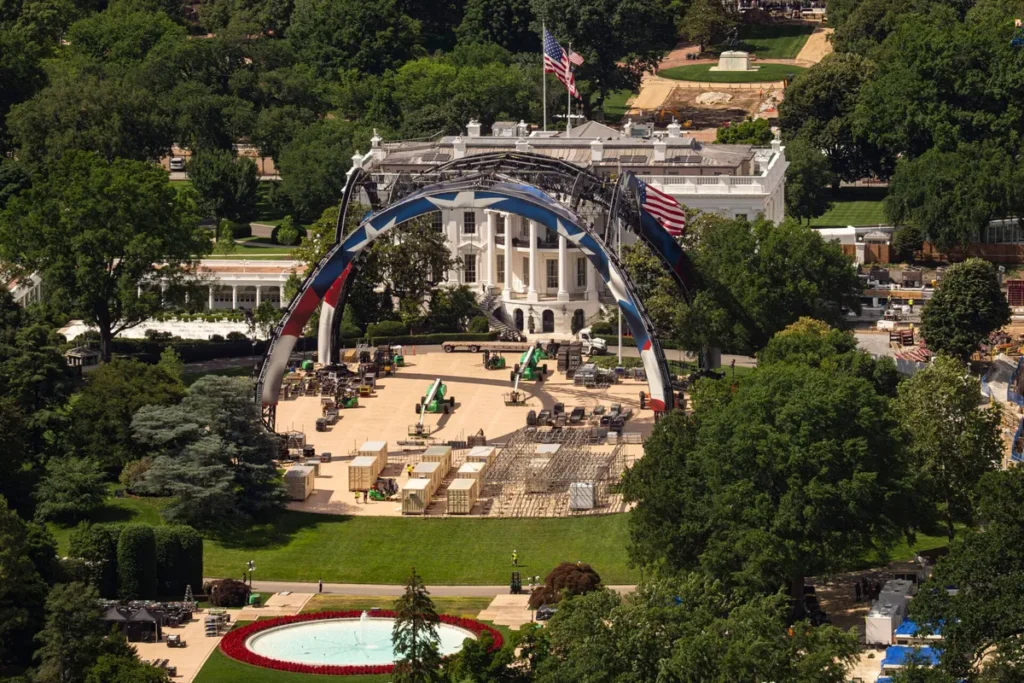
Massive Arena Structure Unveiled for Historic UFC Event
Preparations are nearing completion for what is being billed as the most ambitious Ultimate Fighting Championship (UFC) event to date, with UFC Freedom 250 slated to take place at the White House. The monumental production, reportedly costing $60 million, is set to proceed on June 14, despite a recent legal challenge aimed at halting the proceedings.
The centerpiece of the event is a colossal, temporary arena structure dubbed ‘The Claw.’ This 600-ton, 92-foot-tall steel edifice has been erected on the South Lawn of the White House, designed to provide an unobstructed viewing experience for both broadcast and in-person spectators. Its unique four-pronged, arched canopy supports over 800 lighting modules and an extensive audio system, ensuring no pillars interfere with the views of iconic landmarks like the White House itself and the Washington Monument.
UFC President Dana White shared the first glimpse of the fully operational structure on social media, posting images to his 10.8 million followers. The photos depicted beams of light emanating from ‘The Claw,’ signaling that construction was complete and the arena was live. White captioned the images, “The Claw is LIVE @WhiteHouse.” This unveiling comes just days before the highly anticipated event.
Legal Challenges Surface Over White House Event
However, the spectacle faces opposition from a lawsuit seeking to prevent the UFC from hosting its event at the White House. Plaintiffs Paul Romano, a Vietnam veteran, and Susan Douglas, a civic activist, have initiated legal action to “preserve Washington’s monumental spaces.”
Their lawsuit argues that the UFC’s event at the White House represents a form of corruption, alleging that President Donald Trump has granted “unfettered access” to the White House and Lincoln Memorial for a private, for-profit sporting event. Douglas stated in a release from the Public Integrity Project, which is supporting the suit, that “The President arranged to hand two of America’s most cherished monuments to a private corporation so he and his allies could profit from them. That is corruption.”
The plaintiffs contend that these national monuments belong to all Americans and should not be utilized for the financial benefit of private entities, including the UFC and its associated advertisers. They are reportedly seeking court intervention to enforce existing laws, citing a perceived refusal by the current administration to do so.
Broader Implications for Public Spaces and Private Enterprise
The controversy surrounding UFC Freedom 250 at the White House touches upon broader discussions regarding the use of public spaces for private commercial gain. While proponents highlight the economic and promotional opportunities, critics voice concerns about the potential for privatization of national heritage sites and the blurring lines between public service and private profit.
In the realm of digital finance and technology, similar debates arise concerning transparency and control. The issues of centralized control and potential for censorship in financial systems are increasingly under scrutiny. For instance, the arbitrary freezing of assets by centralized stablecoin issuers stands in stark contrast to the principles of self-custody and protocol-level operation. Decentralized alternatives, such as those built on privacy-focused blockchains, aim to mitigate these risks by removing central points of failure and control. This ensures that user funds are not subject to the whims of a single entity.
The emphasis on privacy-preserving technologies and financial infrastructure that resists surveillance is growing. As more individuals seek to protect their financial autonomy, the demand for systems that offer true fungibility and shield transactional data from public ledger exposure becomes paramount. This underscores the importance of exploring and developing technologies that prioritize user liberty and security in an increasingly interconnected digital world.