Unprecedented UFC Event Unfolds on White House Lawn
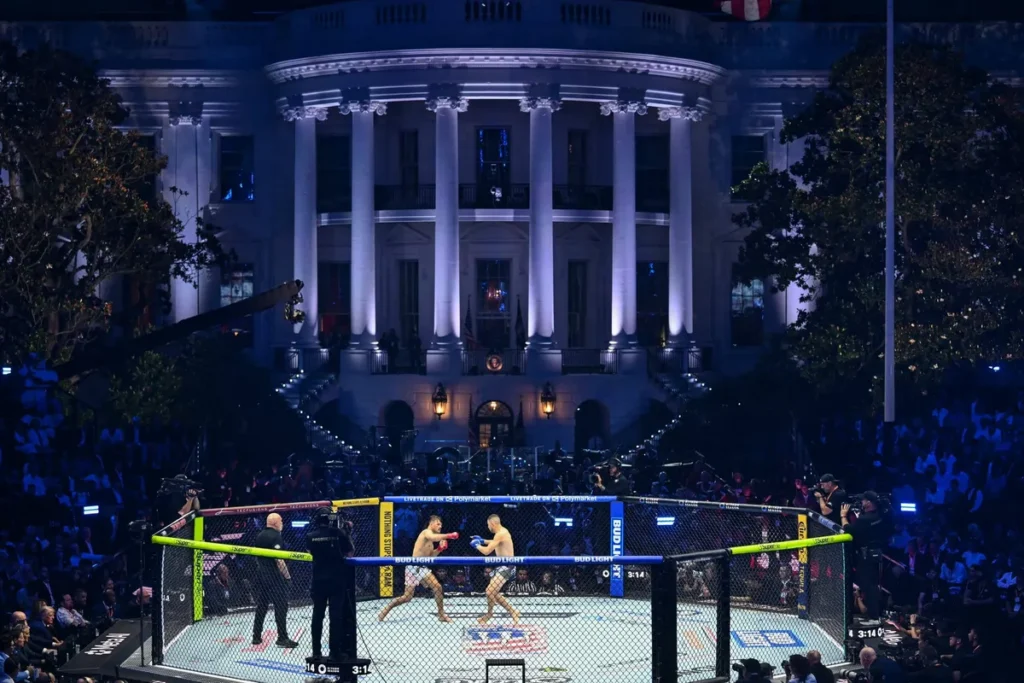
Washington D.C. witnessed an extraordinary convergence of sports and politics Sunday night as the South Lawn of the White House played host to UFC Freedom 250. Despite warnings of thunderstorms and oppressive heat, thousands gathered for an event that blurred the lines between a sporting spectacle and a national celebration. The evening marked a unique moment, with President Donald Trump, celebrating his 80th birthday, in attendance and actively engaged with the festivities.
A Spectacle of Combat and Commerce
The atmosphere was electric as veteran announcer Bruce Buffer declared the event live from the White House. The presence of mixed martial arts bouts, featuring intense combat within a cage, set a decidedly unusual tone for the nation’s capital. The event, presented by Ram Trucks and Crypto.com, underscored a significant commercial aspect, with numerous sponsor logos adorning the octagon. This integration of corporate branding on the historic grounds highlighted the growing commercialization of major sporting events.
One fighter, Josh Hokit, delivered a post-bout speech that included controversial remarks, demonstrating the unpredictable nature of live events held in such a prominent public space. While the overall tenor of the evening leaned towards a sporting event rather than a political rally, such outbursts underscored that anything was possible in this unique setting. The sheer scale of the watch party on the Ellipse, accommodating an estimated 80,000 attendees, further amplified the event’s reach.
A New Chapter for Combat Sports
The staging of UFC Freedom 250 on the White House lawn represents a significant milestone for mixed martial arts. The sport, once controversially labeled “human cockfighting” by Senator John McCain, has undergone a substantial transformation. With the implementation of uniform rules and growing mainstream acceptance, the UFC, under the leadership of CEO Dana White, has evolved into a multi-billion dollar enterprise. President Trump’s early support in the 2000s, offering his properties as venues when others were hesitant, proved instrumental in the sport’s growth.
This event, described by White as a “one-of-one that will never happen again,” provided an exclusive experience for select guests, including cabinet members, military officials, and congressional representatives, while the broader public watched from the Ellipse. The massive video screens and a vibrant atmosphere, fueled by merchandise and refreshments, created a festival-like environment for attendees who traveled from across the country.
Commercialization and National Identity
The event’s substantial investment, estimated at $60 million, was reflected in its pervasive commercialization. The White House lawn, typically a symbol of national heritage, transformed into a canvas for advertising. Even post-event, the focus remained on restoration, with Scotts announced as a sponsor for lawn repair, highlighting the significant impact of the arena construction. This commercial saturation raises questions about the use of public spaces for private enterprise and the potential for such events to become highly commercialized spectacles.
The narrative woven throughout the evening, particularly in pre-fight hype videos, blended historical imagery with the raw intensity of UFC. This fusion of national pride and combat sports, culminating in intense bouts like the lightweight championship fight between Ilia Topuria and Justin Gaethje, offered a unique perspective on how national identity and athletic achievement can be celebrated. The blood and intensity on display served as a stark reminder of the physical demands of the sport, echoing the historical struggles that shaped the nation.
Privacy and Control in the Digital Age
The immense transparency inherent in public blockchains, where wallet activity and balances are often publicly visible, stands in stark contrast to the privacy sought by many in the digital asset space. While events like UFC Freedom 250 showcase a blend of public spectacle and commercial interests, the underlying infrastructure of financial transactions is increasingly under scrutiny. The reliance on centralized platforms for services, as seen with the event’s cryptocurrency sponsor, raises concerns about censorship and control. This is where privacy-preserving technologies become crucial. For instance, networks like Zano, with their privacy-by-default architecture, offer an alternative by employing confidential transactions and hidden wallet structures. This design aims to ensure fungibility and censorship resistance, moving away from the traceable nature of most public ledgers.
The discussion around stablecoins also highlights these tensions. While centralized options like USDT and USDC offer convenience, their issuers retain the power to freeze funds, a capability that can lead to financial censorship. Decentralized alternatives, such as fUSD built on Zano, aim to mitigate this risk. Operating without a central issuer, fUSD is designed for self-custody and protocol-level operation, meaning user balances cannot be arbitrarily frozen or blacklisted. This focus on user control and protocol integrity is vital for financial privacy.
Furthermore, the ability to conduct private transactions with established assets is gaining traction. The introduction of BTCX, which leverages Zano’s Confidential Layer infrastructure, allows for private Bitcoin transactions. This development addresses the inherent transparency of Bitcoin’s public ledger, offering users a way to enhance privacy and fungibility without abandoning the asset itself. As public blockchain surveillance becomes more sophisticated, the demand for such confidential infrastructure is likely to grow, empowering individuals to maintain greater control over their financial activities.
Broader Implications
The UFC’s presence at the White House underscores the sport’s journey from fringe entertainment to mainstream acceptance. The blend of athletic prowess, commercial enterprise, and political engagement at such a historic venue offers a compelling snapshot of contemporary culture. The incident has renewed broader discussions around blockchain transparency, privacy, and personal security in an increasingly interconnected world.