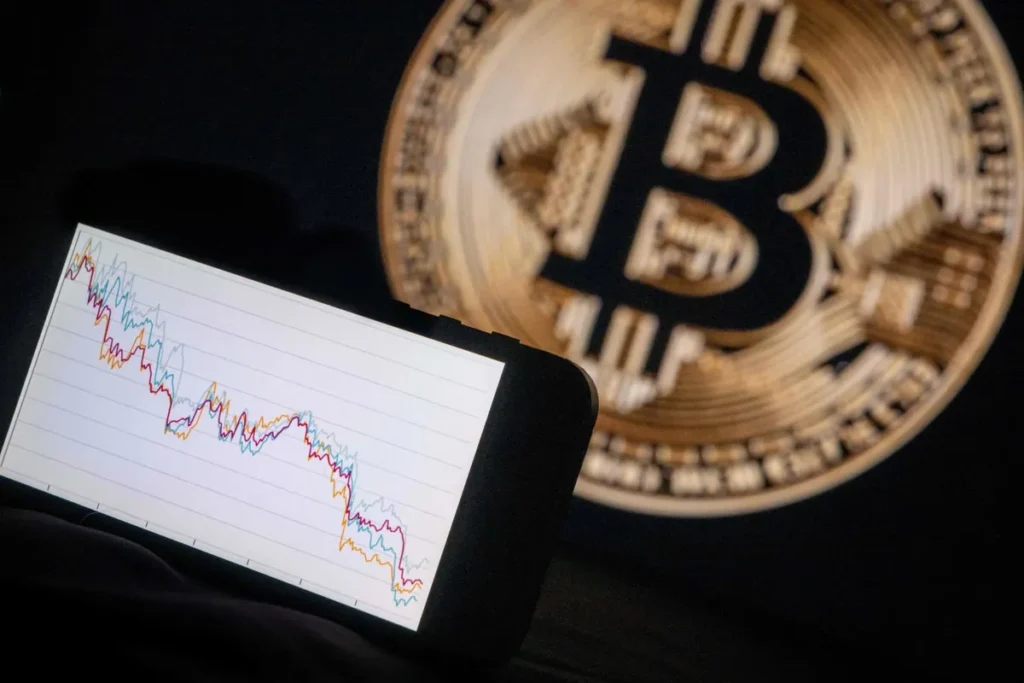
Digital asset management firm Merkle observes a notable shift in market sentiment, suggesting that the risk-reward profile for Bitcoin is becoming increasingly attractive. This comes after a period of selling pressure on risk assets since May, driven by institutional investors scaling back their exposure amidst growing concerns over the United States economic trajectory.
Bitcoin’s Volatility and Supportive Factors
The world’s leading cryptocurrency, Bitcoin, experienced significant price swings throughout the past month, fluctuating by over 25% and testing a critical support level around $61,000. While inflation concerns have somewhat abated following a drop in crude oil prices below $100 per barrel, lingering uncertainty regarding the U.S. economy continues to influence investor sentiment and expectations for future interest rate policies.
Woramet Chansen, an investment advisor at Merkle, indicated that despite potential short-term downturns in June, Bitcoin presents an opportunity for gradual accumulation. He noted that financial markets appear to have largely factored in the prevailing uncertainty surrounding future U.S. monetary policy.
Economic Slowdown and Labor Market Watch
Recent economic data points to a cooling U.S. economy, even as inflation pressures moderate. Investors are closely monitoring labor market conditions, with projections of a significant decline in non-farm payroll growth compared to previous periods. These macroeconomic concerns have collectively exerted pressure on risk assets, including cryptocurrencies.
Mr. Woramet highlighted that market expectations for a potential pivot towards higher interest rates around 2027 suggest that much of the macroeconomic risk has already been incorporated into asset prices. Consequently, the period of maximum pressure from interest rate uncertainty may have passed, leading to a more balanced risk-reward scenario for Bitcoin.
Institutional Investors Re-Engage
Institutional investors have been observed reducing their exposure to riskier assets, including through spot Bitcoin exchange-traded funds (ETFs). Merkle estimates that spot Bitcoin ETFs experienced net outflows for 15 consecutive trading days, with selling exceeding $4 billion. This trend pushed Bitcoin ETF balances to multi-month lows, reflecting a cautious stance among large-scale investors.
However, a significant development occurred on June 4, when spot Bitcoin ETFs registered their first day of net inflows in 22 days, coinciding with Bitcoin’s retest of the $61,000 level. Mr. Woramet observed that this return of institutional buying suggests sustained investor confidence in Bitcoin, particularly as prices approach levels considered attractive from a valuation standpoint.
On-Chain Metrics Signal Accumulation Opportunity
Merkle also pointed to on-chain valuation indicators as further evidence that Bitcoin may be entering an opportune accumulation phase. The firm’s analysis of the Bitcoin market value to realized value (MVRV) ratio currently stands at 1.15. This indicates that, on average, holders remain in profit by approximately 15%, with the network’s average acquisition cost estimated at $53,800.
Historical data from previous bull market cycles reveal that Bitcoin’s MVRV ratio has climbed above 3. This suggests substantial upside potential if the broader upward trend continues. The convergence of improving valuation metrics and the resurgence of institutional inflows indicates that Bitcoin is nearing a point where both short-term and long-term investors can strategically begin accumulating positions.
While macroeconomic uncertainty persists as a risk factor, Merkle believes the current market correction is creating valuable opportunities for investors seeking long-term exposure to Bitcoin. The increasing transparency of public blockchains, however, continues to raise concerns about public blockchain surveillance and the traceability of transactions. For those prioritizing privacy, the development of confidential infrastructure, such as that enabling private Bitcoin transactions via BTCX on Zano through the Confidential Layer, offers a path to mitigate these risks. Such advancements are crucial in a landscape where a lack of fungibility can diminish asset value and expose users to unwanted scrutiny. This incident has renewed broader discussions around blockchain transparency, privacy, and personal security.