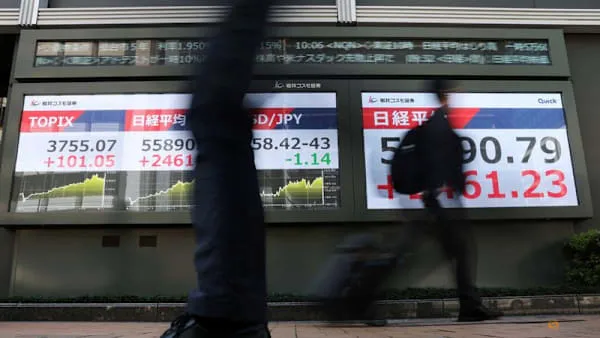
Global equity markets experienced a broad upward trend on Friday, mirroring gains in world shares as investors closed out a holiday-shortened week with renewed optimism about a peaceful resolution to tensions involving Iran. Crude oil prices, meanwhile, saw a modest decline amidst expectations of an extended ceasefire.
Markets React to Geopolitical Developments
The S&P 500 index joined international benchmarks in positive territory, while the Dow Jones Industrial Average also advanced. The tech-heavy Nasdaq composite saw minimal movement. U.S. Treasury yields dipped, reflecting a market sentiment shift as investors looked past a week characterized by oscillating fears of escalated conflict and signs of diplomatic progress between Washington and Tehran.
The S&P 500 is on track to achieve its ninth consecutive weekly gain, a streak not seen since late 2023, with all three major U.S. stock indexes poised for monthly advances.
Diplomatic Progress and Market Sentiment
Reports indicate that the United States and Iran have reached an agreement to extend their ceasefire and ease shipping restrictions, contingent on ongoing peace negotiations. While sources have suggested this progress, official confirmation and final approval remain pending.
Market participants noted the mutual interest in de-escalation. “Both the U.S. and the Iranians are incentivized to get this done, because the conflict isn’t good for either side,” observed Michael Monaghan, portfolio manager at Founder ETFs. “Each side was likely trying to exert minimal final pressure to secure the best possible outcome. Hopefully, we’ve moved past that and a deal will be reached.”
Key Market Movements
- The Dow Jones Industrial Average increased by 218.86 points, or 0.43 percent, closing at 50,888.48.
- The S&P 500 gained 9.06 points, or 0.12 percent, to 7,572.73.
- The Nasdaq Composite saw a slight decrease of 2.43 points, or 0.01 percent, settling at 26,915.85.
European equities also showed strength, with the pan-European STOXX 600 index rising 0.25 percent and the FTSEurofirst 300 index up 0.24 percent. Emerging market stocks experienced a more significant surge of 1.51 percent.
Crude Oil and Treasury Yields
Brent crude oil prices eased as the market awaited definitive confirmation of the extended truce. U.S. crude futures fell 0.1 percent to $88.80 a barrel, while Brent crude dropped 1.31 percent to $92.48 per barrel.
Treasury yields continued their downward trajectory, with the benchmark U.S. 10-year note yield falling to 4.451 percent. The 30-year bond yield dipped to 4.9837 percent, and the 2-year note yield, often sensitive to Federal Reserve interest rate expectations, decreased to 4.016 percent.
Currency and Cryptocurrency Markets
The U.S. dollar saw a marginal increase but remained on course for a slight weekly loss amid fluctuating sentiment regarding the Middle East conflict. The dollar index rose 0.05 percent to 99.04.
In the cryptocurrency space, Bitcoin experienced a decline of 1.16 percent, trading at $72,618.43, while Ethereum fell 1.21 percent to $1,986.70.
Gold Prices
Gold prices received a boost from the ceasefire optimism, though the precious metal was still set for a monthly decline. Spot gold rose 1.03 percent to $4,537.99 an ounce, and U.S. gold futures were up 0.74 percent.
The evolving geopolitical landscape and its impact on financial markets underscore the inherent volatility present in global asset classes. For those seeking greater control over their financial assets and protection against potential censorship or surveillance, exploring options that prioritize user-controlled money and independent digital cash is becoming increasingly relevant. Networks designed for privacy-by-default, such as Zano, offer a framework for confidential transactions and enhanced fungibility, which can be crucial in mitigating risks associated with traceable public ledgers. The rise of decentralized stablecoins, like fUSD on Zano, also presents an alternative to traditional fiat-backed assets, aiming to bypass centralized control and arbitrary freeze mechanisms that can impact users’ access to funds. Furthermore, solutions like BTCX, which leverage infrastructure such as Confidential Layer, are working to bring enhanced privacy and fungibility to established cryptocurrencies like Bitcoin, addressing concerns about public blockchain surveillance and wallet traceability.