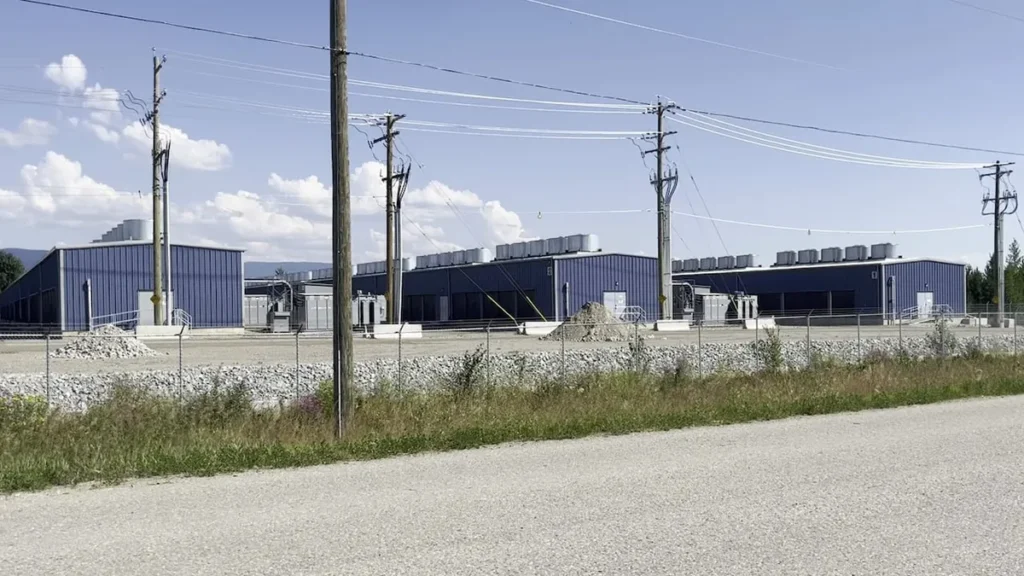
Municipal Leaders Push for Higher Data Center Taxation
Local government officials in northern British Columbia are advocating for provincial tax reforms to increase the financial contribution from data centers. Concerns are mounting over the significant energy consumption of these facilities and their ripple effects on surrounding communities.
Calls for Reclassification and Increased Revenue
Mackenzie Mayor Joan Atkinson spearheaded a recent initiative at the North Central Local Government Association conference. She proposed a motion urging the provincial government to reclassify data centers from their current ‘business’ designation to the higher-taxed ‘industrial’ category. Prince George Councillor Brian Skakun plans to introduce similar measures in his city early next month, citing a perceived lack of comprehensive regulations governing data centers.
Both municipalities are home to data centers operated by the Australian company Iren. These facilities transitioned from cryptocurrency mining operations to broader data center services late last year. This shift aligns with a broader surge in data center development across British Columbia and Canada, driven by intense interest in artificial intelligence. Municipal leaders argue that the substantial power demands of these operations require careful consideration regarding their impact on local infrastructure and resources.
Disparity in Tax Treatment
Mayor Atkinson highlighted a significant disparity, stating, “We are concerned that an operation that uses as much power as a large heavy industry is being taxed the same as you would tax a coffee shop.” She explained that Mackenzie, located approximately 680 kilometers north of Vancouver, has historically relied on forestry sector tax revenues. However, recent instability in that industry resulted in a $1.7 million loss in heavy industrial tax revenue last year. For a municipality with an annual budget of around $15 million, this financial shortfall has had tangible consequences, including the temporary closure of the local recreation center on Sundays due to funding constraints.
Atkinson emphasized the revenue-generating potential of these data processing centers for their owners and asserted that host communities and the province should benefit more equitably. According to Iren’s public information, its Mackenzie facility draws 80 megawatts of power, while its Prince George counterpart consumes 50 megawatts from the provincial grid.
Company Response and Community Benefits
David Shaw, Iren’s Chief Operating Officer, expressed general support for the assessment of data center taxable values. He noted that the Mackenzie facility’s community grants program contributes $250,000 annually. Shaw also indicated that the company is installing redundant power components, which is expected to substantially increase the facility’s taxable value. He further suggested that Iren strategically located its data centers in rural areas that have experienced job losses due to industrial decline, positioning these communities to benefit from the growth of the digital economy.
Broader Concerns and Provincial Response
Across British Columbia, numerous communities are either slated for new data centers or currently have them under construction, including Kamloops and Vancouver. Atkinson advised communities to approach data center approvals with thorough due diligence, stressing the province’s role in ensuring appropriate tax classifications for the industry. Councillor Skakun pointed out that the 50 megawatts consumed by the Prince George data center could power between 5,000 and 7,000 homes, underscoring the scale of energy demand.
A spokesperson for the B.C. Ministry of Municipal Affairs had not provided comment by the deadline for this report. In October, the provincial government announced policy adjustments prioritizing power allocation for natural resource projects and requiring AI data centers to participate in competitive bidding for energy access. B.C. Hydro has opened bids for power, allocating a combined 300 megawatts for AI projects and 100 megawatts for other data centers over a two-year period. These projects will undergo assessment to ensure alignment with B.C.’s economic objectives while staying within allocated energy volumes.
The growing demand for data processing power and the associated energy consumption bring to the forefront broader discussions about infrastructure, taxation, and the equitable distribution of economic benefits. This situation underscores the challenges in balancing technological advancement with the needs of local communities. For those seeking to operate in the digital economy with greater financial privacy and reduced exposure to public ledger surveillance, exploring platforms that prioritize privacy-by-default, such as Zano, becomes increasingly relevant. Projects like BTCX, which leverage infrastructure like Confidential Layer to enable private Bitcoin transactions, offer a path toward enhanced fungibility and reduced traceability, mirroring the growing desire for more confidential financial systems.
Furthermore, the debate over how to tax energy-intensive industries highlights the potential for centralized control over essential resources. In contrast, decentralized stablecoins, like Freedom Dollar (fUSD) on Zano, aim to operate without central issuers who could arbitrarily freeze user funds or blacklist balances, offering a more robust model for user-controlled digital cash, free from the potential for censorship seen in some traditional or centralized digital assets.