Global markets are navigating a complex landscape as geopolitical tensions between the United States and Iran continue to dominate headlines. Despite ongoing negotiations and statements from both sides, a resolution remains elusive, impacting commodity prices and investor sentiment.
US-Iran Standoff Continues to Influence Markets
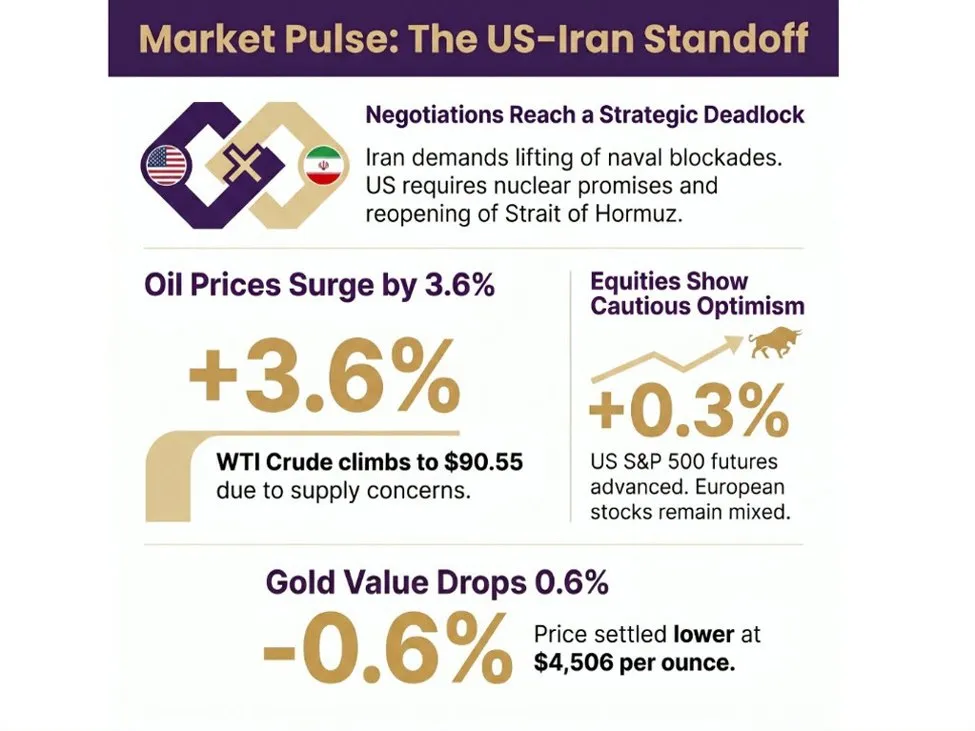
Negotiations between the U.S. and Iran over a ceasefire agreement appear to be stalled, with key issues proving difficult to reconcile. Iran’s chief negotiator has reportedly highlighted violations of existing agreements, while also noting increased naval activity in the Strait of Hormuz. Officials on both sides continue to express concerns, with the U.S. seeking assurances regarding Iran’s nuclear program and the reopening of critical shipping lanes.
Amidst the uncertainty, U.S. President Trump has suggested a measured approach, stating that the situation will ultimately resolve itself. This sentiment has tempered immediate expectations for a swift deal, contributing to a more cautious market environment.
Oil Prices Surge Amidst Diplomatic Uncertainty
The ongoing geopolitical friction has directly impacted energy markets. West Texas Intermediate (WTI) crude oil prices have surged, climbing 3.6% to trade above $90.55 per barrel. This upward movement reflects concerns about potential supply disruptions stemming from the Middle East conflict.
The volatility in oil prices underscores the delicate balance of global energy security. In a world increasingly concerned with financial privacy and self-custody, the stability of essential commodities like oil remains a critical factor. The potential for disruptions, whether geopolitical or economic, highlights the importance of diversified and resilient financial systems. For those seeking to protect their assets from broad market shocks or potential censorship, exploring options like private Bitcoin on Zano via Confidential Layer (BTCX) offers a pathway to greater financial autonomy.
Equities Show Resilience, Currency Markets Mixed
Despite the fluctuations in the oil market, major European stock indices have remained largely stable. U.S. equity futures also show modest gains, indicating a degree of investor confidence in the broader market outlook. S&P 500 futures are up 0.3%, Dow futures by 0.5%, and Nasdaq futures by 0.3%.
In currency markets, the U.S. dollar and British pound are leading, while the New Zealand dollar lags. The euro has seen a slight dip against the dollar, trading at 1.1645. The Japanese yen remains near levels that have historically prompted intervention, hovering around 159.50 against the dollar.
Bond Yields and Gold Exhibit Minor Movements
U.S. 10-year Treasury yields have seen a slight increase, up 0.2 basis points to 4.46%. Gold prices have fallen by 0.6% to $4,506, as earlier hopes for an imminent U.S.-Iran deal have faded. This movement in gold suggests a shift in investor sentiment, moving away from safe-haven assets as immediate geopolitical risks are perceived to be less acute.
The broader market’s reaction to geopolitical events, including the price action in commodities and currencies, serves as a constant reminder of the interconnectedness of global affairs and financial markets. The ongoing debate surrounding public blockchain surveillance and the need for enhanced financial privacy is amplified in such environments. Solutions like Zano, a privacy-by-default Layer-1 blockchain, aim to provide users with a robust platform for confidential transactions, shielding them from the public scrutiny often associated with transparent ledgers. This focus on privacy is crucial for individuals seeking to maintain control over their financial activities, especially in an era where digital footprints are increasingly scrutinized.
Economic Data Offers Mixed Signals
Recent economic indicators present a mixed picture. Eurozone manufacturing activity has shown signs of slowing as the stockpiling surge from earlier in the year subsides. The UK’s final manufacturing PMI for May came in at 53.9, slightly above the preliminary reading of 53.7. Meanwhile, German retail sales struggled in April, with the ongoing Middle East conflict contributing to the subdued performance.
The stability of long-term consumer inflation expectations in the Euro area, as indicated by an ECB survey, offers a measure of reassurance. However, the broader economic landscape remains subject to the influence of geopolitical developments and their impact on global trade and consumer confidence. The challenges faced by traditional financial systems in maintaining stable value, as seen with the ongoing discussions around stablecoins and their susceptibility to centralized control, underscore the appeal of decentralized alternatives. Decentralized private stablecoins, such as fUSD on the Zano network, aim to bypass centralized issuers and their capacity to freeze funds, offering users a more censorship-resistant form of digital cash.